

How To Factor Special Cases
Learning Objectives
- Special Cases – Squares
- Factor a polynomial of the form: \({a}^{two}+2ab+{b}^{2}\)
- Factor a polynomial of the form: \({a}^{2}-{b}^{two}\)
- Special Cases – Cubes
-
- Factor the sum of cubes.
- Gene the deviation of cubes
- More Factoring Methods
-
- Factor expressions with negative exponents
- Gene by exchange
- Factor completely
Why acquire how to factor special cases?

Some people enjoy finding patterns in the world effectually them. Information technology's like a game or a puzzle for them. At that place are some polynomials that, when factored, follow a specific pattern. Recognizing those patterns tin provide a brusque-cutting to the solution. In this lesson you volition see you can factor each of these types of polynomials following a specific design. Yous will also learn how to factor polynomials that have negative exponents.
Special Patterns:
Perfect square trinomials of the form: \({a}^{2}+2ab+{b}^{2}\)
A difference of squares: \({a}^{2}-{b}^{2}\)
A sum of cubes: \({a}^{iii}+{b}^{3}\)
A difference of cubes: \({a}^{iii}-{b}^{three}\)
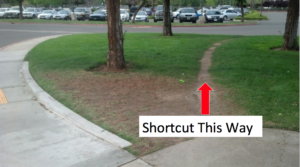
Some people discover it helpful to know when they can take a shortcut to avoid doing extra work. There are some polynomials that will e'er factor a certain way, and for those we offering a shortcut. Most people find it helpful to memorize the factored course of a perfect square trinomial or a difference of squares. The most important skill you lot will learn in this department will be recognizing when yous can utilize the shortcuts. Keep in mind, though, that these are only shortcuts - you have already learned all that is needed to factor trinomials, so you don't have to memorize patterns if you don't want to. Your work make take longer, but y'all volition still attain the correct reply.
Factoring a Perfect Foursquare Trinomial
A perfect square trinomial is a trinomial that can be written as the foursquare of a binomial. Remember that when a binomial is squared, the issue is the foursquare of the commencement term added to twice the product of the two terms and the square of the last term.
\(\begin{array}{ccc}\hfill {a}^{2}+2ab+{b}^{2}& =& {\left(a+b\right)}^{2}\hfill \\ & \text{and}& \\ \hfill {a}^{2}-2ab+{b}^{two}& =& {\left(a-b\right)}^{2}\hfill \cease{array}\)
Nosotros can use this equation to factor any perfect square trinomial. In the following instance we will evidence you how to define \(a\) and \(b\) then yous tin use the shortcut.
Exercises
Factor \(25{x}^{2}+20x+four\).
In the side by side example, we will prove that nosotros can use \(i = 1^ii\) to factor a polynomial with a term equal to ane.
Case
Gene \(49{x}^{2}-14x+i\).
In the post-obit video we provide some other short description of what a perfect square trinomial is, and show how to factor them using a the formula.
We tin summarize our process in the post-obit mode:
Given a perfect foursquare trinomial, factor information technology into the square of a binomial.
- Confirm that the start and last term are perfect squares.
- Ostend that the middle term is twice the production of \(ab\).
- Write the factored form as \({\left(a+b\right)}^{two}\), or\({\left(a-b\right)}^{2}\).
Nosotros volition return to the concept of perfect squares when we solve quadratic equations later in the course.
Factoring a Difference of Squares
A difference of squares is a perfect square subtracted from a perfect foursquare. Recall that a divergence of squares tin be rewritten equally factors containing the same terms but opposite signs because the middle terms cancel each other out when the 2 factors are multiplied.
\({a}^{2}-{b}^{2}=\left(a+b\right)\left(a-b\right)\)
We can use this equation to factor any differences of squares.
A Full general Note: Differences of Squares
A difference of squares can exist rewritten as two factors containing the same terms just contrary signs.
\({a}^{2}-{b}^{2}=\left(a+b\right)\left(a-b\correct)\)
Example
Gene \(9{x}^{ii}-25\).
The virtually helpful thing for recognizing a difference of squares that can be factored with the shortcut is knowing which numbers are perfect squares, as you will see in the next example.
Instance
Factor \(81{y}^{2}-144\).
In the post-obit video nosotros show another example of how to utilise the formula for factoring a deviation of squares.
We tin summarize the process for factoring a difference of squares with the shortcut this way:
How To: Given a difference of squares, factor information technology into binomials.
- Confirm that the first and last term are perfect squares, and that they are subtracted from each other.
- Write the factored form as \(\left(a+b\right)\left(a-b\correct)\).
Notice that after distributing the departure of squares, the polynomial has no \(x\) term. We will render to the concept of a difference of squares when nosotros rationalize radical denominators later on in the course.
Think Near It
Is there a formula to cistron the sum of squares, \(a^2+b^two\), into a production of two binomials?
Write down some ideas for how you would answer this in the box below earlier you lot look at the reply.
Cubes
Some interesting patterns arise when you are working with cubed quantities inside polynomials. Specifically, there are two more special cases to consider: \(a^{3}+b^{3}\) and \(a^{3}-b^{3}\). These cases arise rarely in practice. The key matter to know is that they can be factored, and a quick cyberspace search for "factoring cubes" will refresh your memory regarding the precise pattern.
Sum of Cubes
The term "cubed" is used to depict a number raised to the third power. In geometry, a cube is a six-sided shape with equal width, length, and height; since all these measures are equal, the volume of a cube with width x can be represented by \(x^{iii}\). (Notice the exponent!)
Cubed numbers get large very quickly. \(ane^{3}=1\), \(2^{3}=viii\), \(3^{3}=27\), \(4^{3}=64\), and \(5^{iii}=125\).
Information technology turns out that \(a^{3}+b^{3}\) tin actually be factored as \(\left(a+b\correct)\left(a^{2}-ab+b^{ii}\right)\). Let's bank check these factors by multiplying.
Example
Does \((a+b)(a^{ii}-ab+b^{ii})=a^{three}+b^{iii}\)?
Did you run into that? 4 of the terms cancelled out, leaving us with the (seemingly) simple binomial \(a^{3}+b^{3}\). Then, the factors are correct.
You can use this pattern to gene binomials in the course \(a^{three}+b^{3}\), otherwise known equally "the sum of cubes."
The Sum of Cubes
A binomial in the grade \(a^{iii}+b^{iii}\) can exist factored as \(\left(a+b\correct)\left(a^{2}-ab+b^{2}\right)\).
Examples:
The factored form of \(x^{3}+64\) is \(\left(x+4\right)\left(x^{two}-4x+xvi\right)\).
The factored class of \(8x^{3}+y^{3}\) is \(\left(2x+y\correct)\left(4x^{2}-2xy+y^{2}\right)\).
Case
Factor \(x^{three}+8y^{3}\).
And that'south information technology. The binomial \(x^{3}+8y^{three}\) tin exist factored every bit \(\left(x+2y\right)\left(x^{2}-2xy+4y^{2}\correct)\)! Let's attempt some other one.
Remember, y'all should ever look for a GCF earlier you follow any of the patterns for factoring. Do not skip this step!
Example
Cistron \(16m^{3}+54n^{iii}\).
Difference of Cubes
Having seen how binomials in the form \(a^{3}+b^{iii}\) can be factored, it should not come as a surprise that binomials in the course \(a^{3}-b^{3}\) can be factored in a similar way.
The Difference of Cubes
A binomial in the grade \(a^{3}-b^{3}\) can be factored as \(\left(a-b\right)\left(a^{2}+ab+b^{2}\right)\).
Examples
The factored form of \(ten^{3}-64\) is \(\left(x-4\right)\left(x^{ii}+4x+xvi\right)\).
The factored course of \(27x^{three}-8y^{3}\) is \(\left(3x-2y\left)\correct(9x^{2}+6xy+4y^{two}\correct)\).
Let'southward go ahead and expect at a couple of examples. Remember to factor out all common factors first.
Case
Factor \(8x^{3}-1,000\).
In the following two video examples nosotros show more binomials that tin can be factored as a sum or departure of cubes.
Negative Exponents
Expressions with negative exponents can be factored using the same factoring techniques as those with integer exponents. It is of import to recall a couple of things offset.
- When you multiply ii exponentiated terms with the aforementioned base, you can add the exponents: \(10^{-1}\cdot{x^{-1}}=x^{-1+(-1)}=x^{-2}\)
this is the aforementioned as:
\(\frac{1}{x}\cdot{\frac{ane}{ten}}=\frac{1}{x^2}\) - Polynomials have positive integer exponents – if it has a negative exponent it is just called an expression.
First, let's practice finding a GCF that is a negative exponent.
Example
Factor \(12y^{-three}-2y^{-ii}\)
Now let's factor a trinomial that has negative exponents.
Example
Factor \(x^{-2}+5x^{-1}+vi\).
In the next instance we will meet a departure of squares with negative exponents. We can use the same shortcut as we have before, but be careful with the exponent.
Case
Factor \(25x^{-iv}-36\)
In the following video examples you will run into more examples that are similar to the previous three written examples.
Factor Using Substitution
Nosotros are going to move back to factoring polynomials, and then our exponents will be positive integers. Sometimes nosotros encounter a polynomial that looks similar to something we know how to factor, but isn't quite the same. Substitution is a useful tool that can be used to "mask" a term or expression to brand algebraic operations easier. We can use substitution to factor polynomials with larger exponents. In the next case we will see how nosotros can utilise substitution to cistron a fourth degree polynomial.
Case
Factor \(ten^4+3x^2+2\)
In the following video we evidence ii more than examples of how to use exchange to factor a 4th degree polynomial and an expression with fractional exponents.
Factor Completely
Sometimes you may encounter a polynomial that takes an actress step to factor. In our next example we volition first find the GCF of a trinomial, and afterwards factoring information technology out nosotros volition be able to factor once more and then that we stop up with a production of a monomial, and two binomials.
Example
Factor completely \(6m^2k-3mk-3k\).
In our final example we bear witness that it is of import to factor out a GCF if in that location is one before you existence using the techniques shown in this module.
Summary
In this section we used factoring with special cases, and we saw how to factor expressions with negative and fractional exponents. We also returned to factoring polynomials and used the substitution method to factor a 4th degree polynomial. The final topic we covered was what it means to gene completely.

How To Factor Special Cases,
Source: http://matcmath.org/press/4-2-special-cases-in-polynomial-factoring/
Posted by: shawyoucent.blogspot.com
0 Response to "How To Factor Special Cases"
Post a Comment