

How To Place Shankh In Mandir
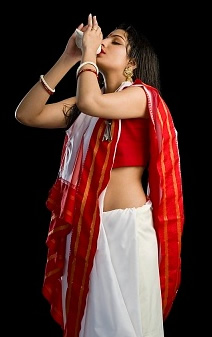
'Shankh' is of greater importance in Hinduism and Buddhism. In Hinduism the 'Shankh' is defended to Lord 'Vishnu'. 'Shankha' is highly praised in Hindu scriptuers every bit a giver of fame and prosperity. 'Shankh' is of two types i is for blow sound and other for the worship purpose. The daily bravado of the 'shankh' does save the person from the eye diseases.
Types of Shankha
Dakshinavarti Shankha
Vamavarti Shankha
Gaumukhi Shankha
Ganesha Shankha
Kauri Shankha
Moti Shankha
Heera Shankha
Shankh in Indian Mythology
- Shankh represents a number - one hundred zillion (or 100,000,000,000,000,000).
- Shankh in Indian mythology is also the name given to one of the 9 treasures held by the god of wealth, Kuber.
- There is an bellboy of Kuber also chosen Shankhnidhi, and he is shown as a corpulent dwarf seated in an easy posture holding a conch crush in 1 of his two hands. His companion is Padmanidhi, who resembles Shankhnidhi in all particulars except that he holds a lotus in his manus instead of a conch shell.
- It is most characteristically associated with Vishnu, and is one of His 4 "Aayudh" weapon', only employed in the sense of whatever is held in the hand commonly establish in his easily; the Discus (Chakra), the Mace (Gadaa) and the Lotus (Padm) existence the other three than Shankh. The conch held past Vishnu is named Paanch-janya Shankh, even every bit the proper noun of the Discus in His hand is Sudarshan and the name of His mace is Kaumodakee.
Importance of conch (shankh) every bit per scriptures
First of all permit u.s.a. se the importance of shankh. According to our ancient scriptuires that is Puranas, the shankh was originated during the Churning of body of water past the Deities and Lord Vishnu held it in the form of weapon. As per a holy verse which is regularly chanted during the puja ritual it is mentioned that by the control of Lord Vishnu the deities Moon, Sun and Varun are stationed at the base of operations of the shankh, the deity Prajapati on its surface and all the places of pilgrimage like Ganga and Saraswati in its front end portion. Notwithstanding another speciality of shankh is that the vibrations emanating on blowing it destroys the disease causing germs in the temper. That is the reason it has a important place in Ayurved and medicine.
Permit u.s. run across a subtle drawing which explains united states of america the importance of shankh.
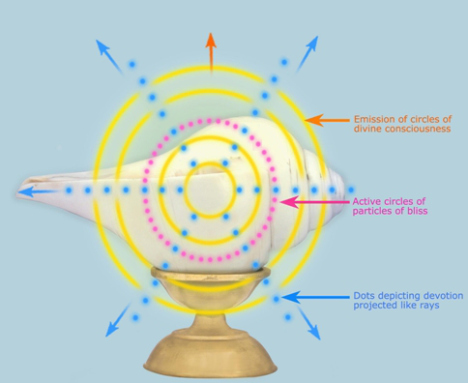
In this subtle drawing nosotros tin can see that the yellow coloured circles of chaitanya are being emitted from shankh in the atmosphere. The subtle bluish coloured dots depicting devotion are projected like rays in straight line. The pink circles are formed of particles of elation (anand) and they are constantly agile.
The direction of the infinite within the shankh divides it into two types. When the infinite is towards your right when you agree the shankh with its tip facing in frontal direction and with the space facing up and so it is right sided shankh and if the space faces to left so it is a left sided shankh. Generally a left sided shankh is preferred for the puja ritual. At present days then many Shanks of different shapes are available in the market. There are some figured works too on their surface. Thus one gets confused every bit to how a genuine shankh be identified? The elementary test is that without blowing the shankh if you hear pleasant audio when you bring it near to your ear then it is a genuine i.
Blowing of Shankh in puja ritual
The shankh is used in 2 ways in a puja ritual. I for blowing before the beginning of ritual and other for actual puja ritual. The shankh which is used for blowing should non be kept for puja.
Bravado of shankh has special significance in puja ritual. It has been mentioned in 'Varaha Puran' that i should non open the door of temple without start blowing the shankh. The left sided shankh is blown before the start of puja or performance of arti. At that place are three types of frequencies in the atmosphere namely sattva dominant, raja dominant and tama dominant. Amid them the raja dominant and tama ascendant frequencies generate distressing vibrations. The sattva dominant frequencies go attracted to the place of puja ritual only these frequencies are opposed past the raja and tama ascendant frequencies so that they practice non reach the place of puja and thus the flow of sattva frequencies is hindered.
When the shankh is blown before the start of puja energy is emitted from the shankh. This energy reduces the strength of distressing frequencies. Besides a protective armour of chaitanya (divine consciousness) is formed effectually the manufactures of puja.
In that location is some other benefit too. That is when the shankh is diddled the activated energy of Lord Vishnu in the universe gets attracted towards the place of worship which is non only beneficial to the person who is blowing the shankh merely too to all those who hear it.
Simply as the shankh is blown before the start of puja, information technology is also blown before an arti. The objective behind this existence to sustain the deity'south chaitanya attracted to the identify of puja ritual and the pure atmosphere generated because of the sattvik frequencies, for a long period.
Effect of free energy emitted from blowing of Shankh
Allow us meet how the energy is emitted from the bravado of shankh and what exactly happens with the assistance of a subtle cartoon. Here nosotros take to have into consideration the fact that while the vibrations of a subtle drawing are three dimensional we see them in the subtle drawing in a two dimensional grade. For example the sphere will appear as a circle. Now allow united states expect at the subtle drawing:
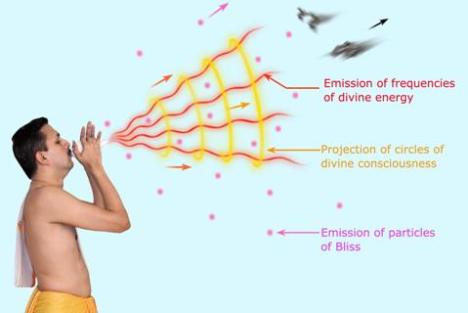
As soon every bit the shankh is blown the frequencies of divine free energy (shakti) are emitted into atmosphere due to sound generated. These energy frequencies are seen in red colour. Along with these free energy frequencies yellow circles of chaitanya are besides projected in the temper. You tin likewise see the pink particles of Bliss being emitted in the temper. This increases the proportion of shakti (free energy), chaitanya and anand in the surround and that is why the negative energies go distressed and run away.
Thus it has become clear to us the importance of blowing shankh during puja ritual. The bravado of shankh makes the atmosphere holy and pure and conducive for the spiritual practice (sadhana) of the individual. Thus it becomes easier for an individual to receive maximum sattvik frequencies emanating from the deities.
Correct method of bravado Shankh
We accept seen that considering of blowing of shankh the frequencies consisting raja-tama particles are destroyed and at the aforementioned time the saviour and destroyer principle of a deity is awakened. Now let us run across the correct method of blowing the shankh.
Get-go slightly heighten your neck and curve it little backwards and go on the listen focused. Accept a deep breath and start to blow with increasing intensity. Ane should go on in listen that bravado of shankh should be completed in one single breath. When the shankh is diddled in this mode Sushumna aqueduct of the private gets activated and it helps in keeping a right balance of raja and sattva particles related to Tej and Vayu elements. This awakens the saviour and destroyer principle of adeity according to the need.
Shankhini
There is another type of shankh which is neither supposed to be blown nor kept in the puja ritual. It is called female person shankh or shankhini. Its surface is rough and thorny. It does not emit pleasant sound. Let us now see why a female shankh or shankhini is not used for bravado as per the scientific discipline of spirituality.
In that location are several crisscross circles on the inner surface of shankhani. When you blow through it these circles create obstruction in the interrupted period of sound vibrations. The sound vibrations when generated rub confronting these circles thereby producing distressing frequencies. These new distressing frequencies further activate the lamentable frequncies already nowadays in the atmosphere. Both the vibrations from the shankhani and those from the negative energies nowadays in the atmosphere become attracte towards the place of puja and make the surrounding atmosphere impure. That is the reason shankhani is not used in the usual puja ritual. Nonetheless the worshippers following the Aghori Vidya (worship to accumulate black energy) use the shankhani for attracting negative energies at the beginning of their worship.
Ritualistic worship of Shankh
During puja ritual the shankh is kept in a specific style. The pointed portion is directed toward the deity.
The frequencies of chaitanya and energy emanating from the images of deities go attracted to the pointed portion of shankh. You can also see the blue coloured Lord Krushna principle getting attracted towards shankh which is producing a armour of of Krushnatattva around shankh. The yellow coloured chaitanya is also attracted and spreads inside the shankh. The scarlet coloured frequencies of free energy are revolving in the space of shankh in a circular way. The frequencies of energy and chaitanya are emitted from the other finish of shankh which purifies the temper and thus benefits the worshipper.
When the shankh is kept with its pointed portion towards the deity and then the business firm gets the free energy emitted from the other end in required amount. Now allow us know nigh ritualistic worship of shankh.
A shankh is filled with h2o prior to actual puja of a deity and following the puja of kalash. Then it is ritualistically worsipped past offerings of sandalwood paste, flowers and Tulsi leaves. After the shankh puja the worshipper sprinkles the h2o filled in shankh on himself and the manufactures of puja. The water filled in shankh is considered as pure every bit water of Ganga river. It is as well used for giving holy bath (abhishek) to the deities.
Important points to be noted while using a Shankh
At present let us now encounter some useful points about shankh
- Never apply shankh meant for blowing in a puja ritual. They should be separate.
- Never offering h2o to the deity past shankh used for blowing.
- Exercise not keep two shankhs for worship in a temple room.
- Never bear on the Shiva pindi with shankh during a puja ritual.
- Never use shankh for giving holy bath to deities Shiva and Sun.
Er. Rameshwar Prasad invites y'all to the Wonderful World of Vastu Shastra

Engineer Rameshwar Prasad
(B.Tech., G.Tech., P.Thousand.D.C.A., P.K.D.M.)
Vaastu International
- 49 C, Pocket-B, SFS Flats,
Mayur Vihar, Stage -3, Delhi 110096 - P: (+91-xi) 22615299, 22615833
- M: (+91) 9810105218, 9654255234
- vaastuinternational@gmail.com
- vaastuinternational@yahoo.com
Source: https://www.vaastuinternational.com/vastu/shankha.html
0 Response to "How To Place Shankh In Mandir"
Post a Comment